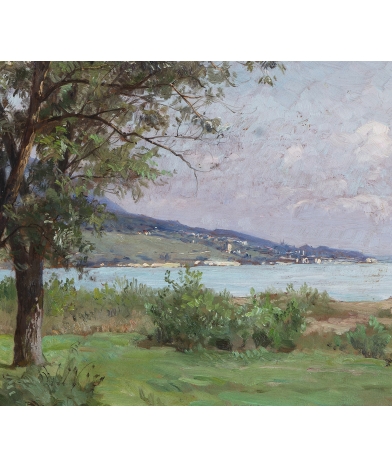

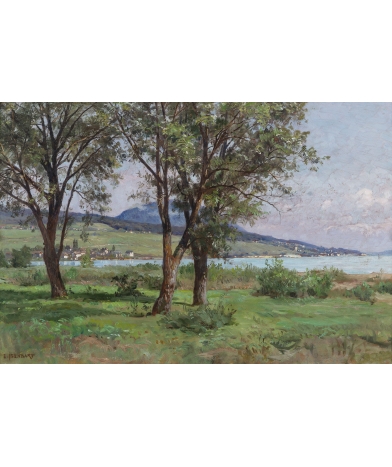
Emile Isenbart (1846-4921) - Lake Neuchâtel
Dimensions : Oil on paper mounted on canvas, signed lower left
At the end of the 19th century, Emile Isenbart established himself as the finest landscape painter of Franche-Comté. Originally from the Doubs region, this painter left us peaceful and wonderful paintings of the area around Besançon and the Jura Mountains. He developed an interest in painting at a very young age. He studied under Antonin Clément Fanart (1831-1903), an excellent realist painter whose work, of comparable quality and power, rivaled that of Gustave Courbet during the same period.
Isenbart painted some mythological subjects, but his immense talent truly shines in his mountain views and waterscapes. From 1872 onward, the artist exhibited at the Salon in Paris, and he became a member of the Salon des Artistes Français in 1888. In 1897, he was made a Knight of the Legion of Honor. Emile Isenbart exhibited landscapes of the Doubs River and the Jura Mountains on several occasions in Vienna and Munich. He received medals at the Universal Expositions of 1889 and 1900.
Isenbart's brushwork is lively, realistic, and at the same time impressionistic. His compositions are meticulously studied, and his technique for depicting rivers and streams is simply remarkable: Isenbart is undoubtedly the French artist who best captured the reflections and ripples of water.
Works by this sensitive painter are in the collections of several important French museums, including a drawing entitled "Perspective of Meadows with Hills on the Horizon" held by the Louvre Museum in Paris. Isenbart also created the frescoes that adorn the walls of the Parliament of Besançon (built in 1582), now the city's courthouse. He died on March 21, 1921, in Besançon.
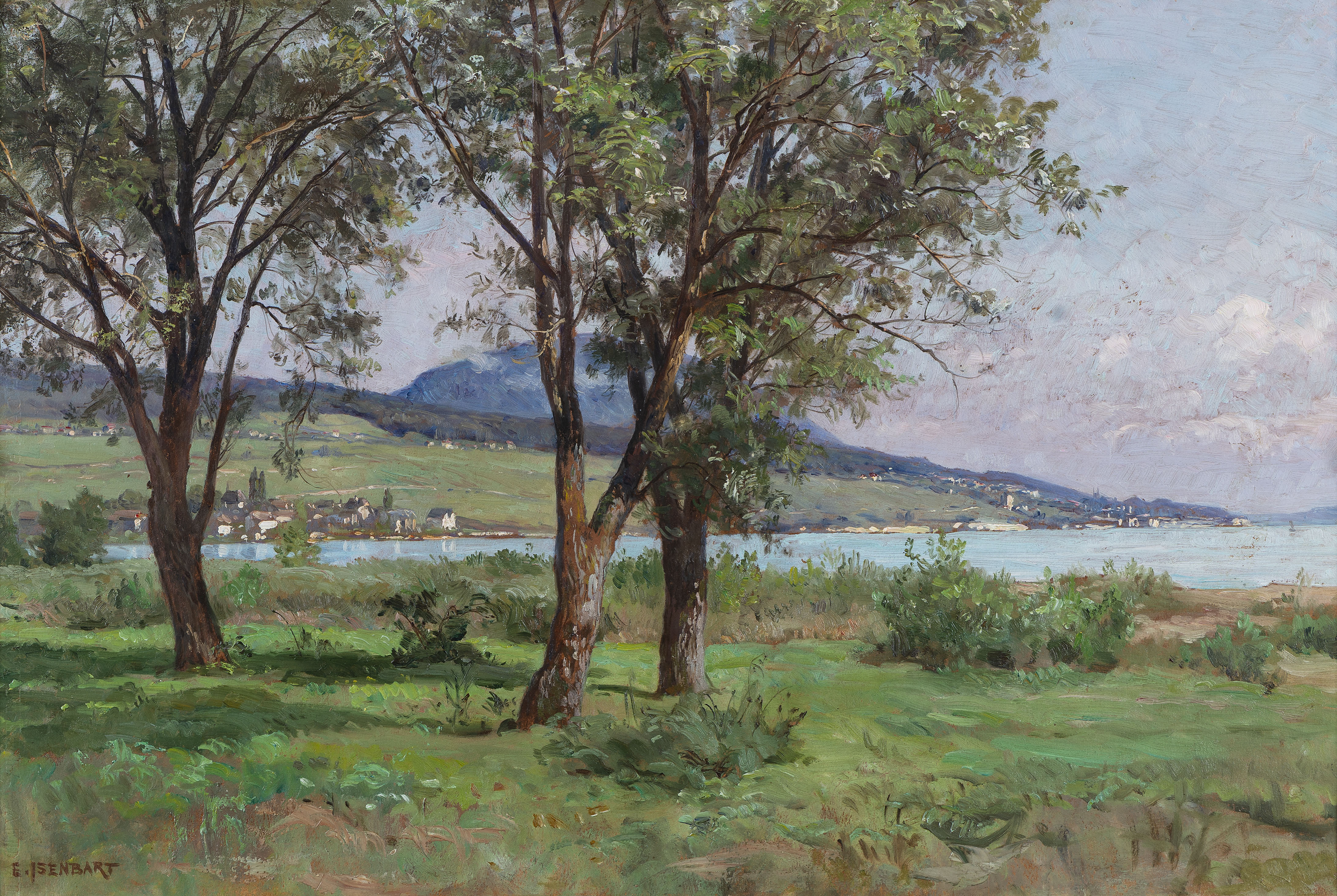
Our Painting is a remarkable work in which Isenbart demonstrates his talent as a draftsman and his profound understanding of nature. The precision and accuracy of the tree depictions are particularly noteworthy.
While Isenbart's paintings of the French Jura are numerous, this view of the Swiss Jura is especially rare. The composition is clever, with a break in the perspective on the right that reveals the opposite bank, where the houses are rendered with skillful, delicate brushstrokes. As is his custom, Isenbart employs an infinite range of green hues in this work. Here again, Isenbart offers us a vision of tranquil and restful nature, almost devoid of human activity.
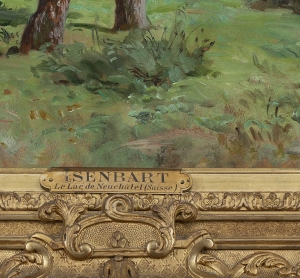
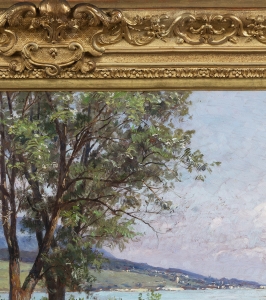
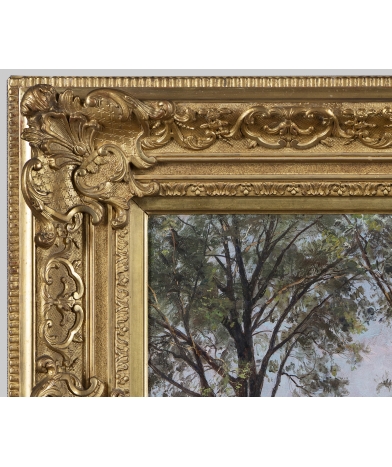
This oil painting is in excellent condition, without any damage or significant restoration. It remains in its beautiful, perfectly restored original frame of wood and gilt stucco.